Dispersion of Barium Sulfate in Coatings and Adhesives
Dispersion of Barium Sulfate in Coatings and Adhesives ! Three-roll mill processing white filled resin paste A stable barium sulfate dispersion depends on three things working together: enough mechanical energy to break agglomerates, a wetting and dispersing additive that keeps the particles apart o…
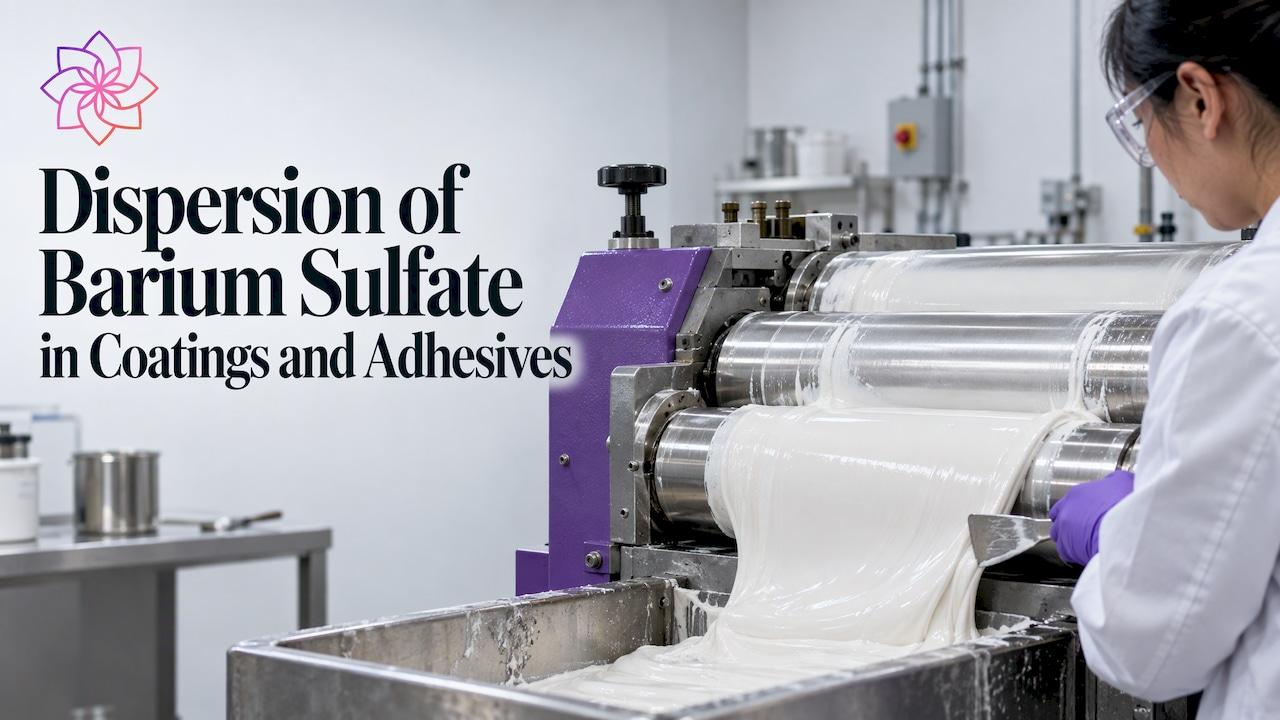
A stable barium sulfate dispersion depends on three things working together: enough mechanical energy to break agglomerates, a wetting and dispersing additive that keeps the particles apart once they are separated, and a rheology package that holds the dense filler in suspension during storage. Barium sulfate (BaSO4) is dense, fine and prone to re-agglomeration, so none of the three can be omitted. ASTRA DISP® dispersants and ASTRA REO® rheology modifiers from Astra Chemical are manufactured for formulators who need to control each of these steps in coatings, adhesives, inks, plastics and composites.
TL;DR
- BaSO4 agglomerates because of van der Waals attraction, moisture and salt bridges, and electrostatic charge. Mixing alone does not reverse this.
- Fine grades (sub-micron to a few microns) improve gloss and smoothness but are the hardest to keep separated. Particle size, surface treatment and storage history all change how a lot behaves in the mill.
- The working recipe is high-shear deagglomeration plus a dispersant that stabilizes the freshly created surface, then a rheology system to control settling.
- Verify the result by fineness of grind, gloss, film appearance and viscosity stability after storage, not by viscosity on the day of manufacture alone.
Barium sulfate is a water-insoluble, high-density mineral filler. In a cured film, it behaves as a physical barrier: in waterborne epoxy protective coatings, settled BaSO4 forms dense platelets that act as a barrier, yet it is very difficult to keep suspended in the can. That sentence describes the whole problem. The properties that make BaSO4 valuable (density, chemical inertness, whiteness) are the same ones that make it settle quickly and pack hard.
Dispersion in practice covers three separate tasks:
- Wetting. The resin or solvent system displaces air and adsorbed moisture from the particle surface.
- Deagglomeration. Mechanical energy (high-speed disperser, bead mill, three-roll mill) breaks agglomerates into the smallest units the grade allows.
- Stabilization. An adsorbed additive layer prevents the particles from re-associating through steric or electrostatic repulsion, so the fineness achieved in the mill is the fineness in the can and in the film.
A formulation that skips the third task often passes a grind gauge at the end of the batch and fails after a few weeks on the shelf.
Why barium sulfate agglomerates
The causes are physical and well understood. Agglomeration of BaSO4 powder is thermodynamically driven: van der Waals forces cause soft agglomeration of ultrafine particles, adsorbed moisture forms liquid bridges, residual salts crystallize into hard bridges on drying, and electrostatic charge from conveying or grinding causes clustering. The consequences in coatings are pitting, lower gloss and hiding, and blocked spray nozzles.
These mechanisms differ in how they respond to processing:
| Mechanism | Origin | Response in the formulation |
|---|---|---|
| Van der Waals attraction | Surface forces between ultrafine particles | Reversible with shear plus wetting and dispersing additive |
| Liquid bridges | Adsorbed moisture | Controlled by drying, storage and wetting of the surface |
| Solid bridges | Residual salts crystallized during drying | Needs sufficient mechanical energy; some bridges persist as hard agglomerates |
| Electrostatic clustering | Charge from conveying or grinding | Reduced once particles are wetted into the liquid phase |
The practical conclusion is that the incoming powder is already partly agglomerated before it reaches the vessel. The dispersion process begins with that history, which is why grade selection matters as much as additive selection.
Particle size, grade and surface treatment
Finer is not automatically easier
Fine and superfine grades give higher gloss and smoother films, which is why they are specified for topcoats and powder coatings. They also carry the largest surface area to wet and the strongest tendency to re-agglomerate. European Patent EP 2,871,209 B1 states that below about 0.01 mm the particles aggregate so strongly that dispersibility in a resin is lost and surface smoothness of the cured material suffers. The lesson for a formulator is to treat particle size as a trade-off between optical or barrier performance and the energy and additive level needed to reach it.
What "deagglomerated" means in a specification
Supplier data sheets often describe a grade as deagglomerated. It helps to read this precisely. A BASF Coatings patent application defines deagglomerated barium sulfate as secondary particles no longer in the agglomerated state normally obtained from precipitation, present as smaller agglomerates suited to hardenable materials, not as fully isolated primary particles. Even a deagglomerated grade therefore still needs a dispersion step and a stabilizing additive.
Surface-treated grades
Inorganic and organic surface treatments improve compatibility with the binder. US Patent 4,551,497 describes depositing barium silicate on BaSO4 and converting it to hydrous silica, with optional further coatings of hydrous metal oxides such as alumina or a silane coupling agent for improved dispersibility. Storage behavior is also a design consideration: a patent on storage-stable barium sulfate reports that conventional particles lose dispersibility in organic and aqueous systems during storage, and describes treating the particles at pH 9 to 12 with water-soluble metal compounds followed by acidification to deposit a metal-oxygen compound on the surface. For a formulator, this means the lot age and storage conditions of the filler belong in the incoming-material record alongside particle size.
Selecting a dispersant for barium sulfate
BaSO4 has a relatively inert, weakly polar surface, so adsorption of the additive onto it is the central question. A dispersant needs an anchoring group that adsorbs on the particle and a stabilizing chain that is compatible with the continuous phase. The selection criteria below apply regardless of supplier.
| Criterion | What to evaluate |
|---|---|
| Continuous phase | Waterborne, solventborne or solvent-free resin; the stabilizing chain must be compatible |
| Filler loading | Higher loading needs more surface coverage and a lower-viscosity grind |
| Particle size of the grade | Finer grades have more surface area and typically need a higher additive dosage |
| Other pigments and fillers | Competitive adsorption with titanium dioxide, clays or organic pigments |
| Downstream properties | Gloss, intercoat adhesion, water sensitivity, foam, recoatability |
Dosage is set on the filler surface, not the batch
The additive level is expressed most meaningfully as a function of filler surface area, so it is determined by a ladder study. Prepare the same millbase with increasing additive levels, measure viscosity after a fixed grind time, and select the dosage at the viscosity minimum or at the plateau after it. Underdosing leaves bare surface and the particles flocculate. Overdosing adds free additive that can affect water resistance and adhesion. Run the ladder again whenever the BaSO4 grade, lot or the resin changes.
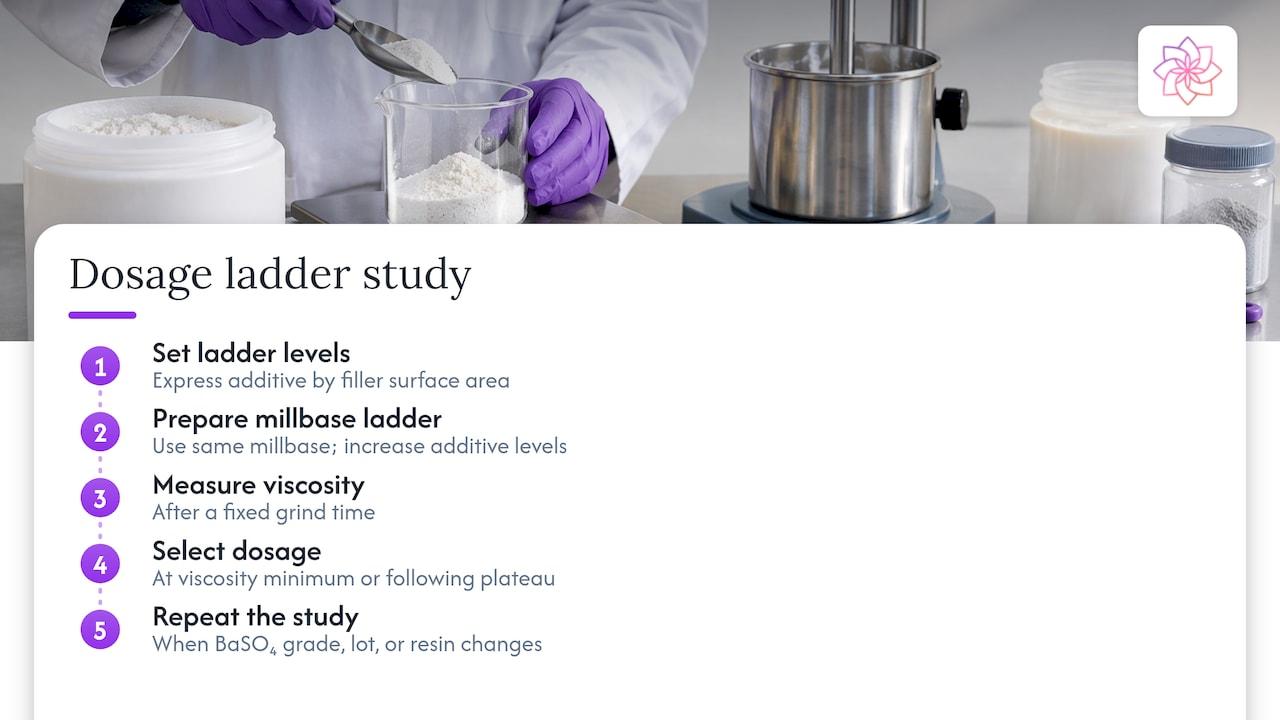
Astra Chemical supplies ASTRA DISP® dispersants with technical support and custom formulation guidance, and offers sample requests, so the dosage ladder can be run on the formulator's own system and filler grade. See the ASTRA DISP® page.
Mixing and milling: a method that holds
The following sequence is a sound baseline for a BaSO4 millbase in a coating or adhesive. The core principle is that natural dispersion cannot overcome the cohesive forces, so high-intensity mechanical stress to break agglomerates must be combined with a surface modification that forms a protective layer against secondary agglomeration.
- Dry the filler where moisture is an issue. Liquid bridges reform whenever adsorbed water is present, and moisture also changes how the additive adsorbs. Record the moisture level of each lot.
- Charge the liquid first. Add the resin or solvent portion, the dispersant and any wetting additive, and defoamer if the system foams under shear. Starting with the additive in place lets it reach the surface as the powder is wetted.
- Add the BaSO4 gradually under moderate agitation. Fast addition into a vortex traps air and produces dry lumps that are very slow to wet out.
- Increase to high shear. Use a dissolver blade at a tip speed suited to the vessel, keeping the vortex stable and avoiding air entrainment. Hold until the viscosity stops falling.
- Mill when the target is fine. For fineness-of-grind targets or high-gloss systems, move to a bead mill or similar. Dense media and tight temperature control are standard because BaSO4 is dense and abrasive on equipment.
- Let down. Add the remaining binder, then the rheology modifier, and check the dispersion again before adjusting viscosity.
- Re-test after storage. Repeat fineness, viscosity and gloss after a heat-aged and a room-temperature storage period.
Foam is a frequent companion problem. High shear and wetting additives entrain air, and a trapped air bubble at the particle surface hinders wetting. Astra Chemical manufactures both silicone (ASTRA DF®) and non-silicone (ASTRA DF NS®) defoamers, which allows the defoamer to be matched to the system and to recoat or intercoat requirements.
Controlling settling with rheology
A good dispersion of a dense filler still settles over time if the continuous phase has no structure. The traditional approach is clay: a clay thixotrope delays settling and controls sag, but usually must be preswelled with an alcohol, which adds a step to paint making. Designing the rheology profile deliberately removes that burden from the process. The target is a high low-shear viscosity (to hold the filler during storage) and shear-thinning behavior under application (for flow and leveling).
Astra Chemical's ASTRA REO® range of rheology modifiers is designed for this role, and the same technical support team can help correlate the rheology profile with the dispersant dosage, since the two interact. A dispersant that lowers millbase viscosity improves wetting, and the rheology modifier is then added at let-down, where it does not compete for the particle surface.
Diagnosing dispersion problems
| Symptom | Likely cause | Direction for correction |
|---|---|---|
| Seeds or pitting in the film | Residual agglomerates; hard solid bridges | More energy at grind stage; finer or deagglomerated grade; check dispersant dosage |
| Gloss or hiding lower than expected | Incomplete deagglomeration | Longer or finer milling; dosage ladder |
| Spray nozzle clogging | Oversized agglomerates in the material | Filtration check; grind gauge; reassess process |
| Viscosity rises on storage | Re-agglomeration; flocculation | Increase surface coverage; review additive compatibility |
| Hard cake in the can | Settling without structure | Rheology modifier; reassess density and loading |
| Craters or foam defects | Air entrainment | Defoamer type and level |
What good looks like in a film
The benefits of a well-dispersed BaSO4 filler show in measurable performance. In a 2023 peer-reviewed Coatings study of polyester powder coatings, BaSO4 at 15% of the remaining components dispersed uniformly with minimal agglomerates larger than 10 µm. The same study reports that combining 2% nanoclay with BaSO4 produced pore resistance two orders of magnitude higher (10^7 Ω·cm² after 25 days of immersion) and a 2500 h salt-spray lifetime, while BaSO4 alone could not improve the barrier effect because film defects outweighed the benefits. The authors also report that the BaSO4 particles acted as an effective dispersing agent for the nanoclay at 2% dosage, breaking up clay agglomerates, while nanoclay levels of 4% and above caused delamination and film defects.
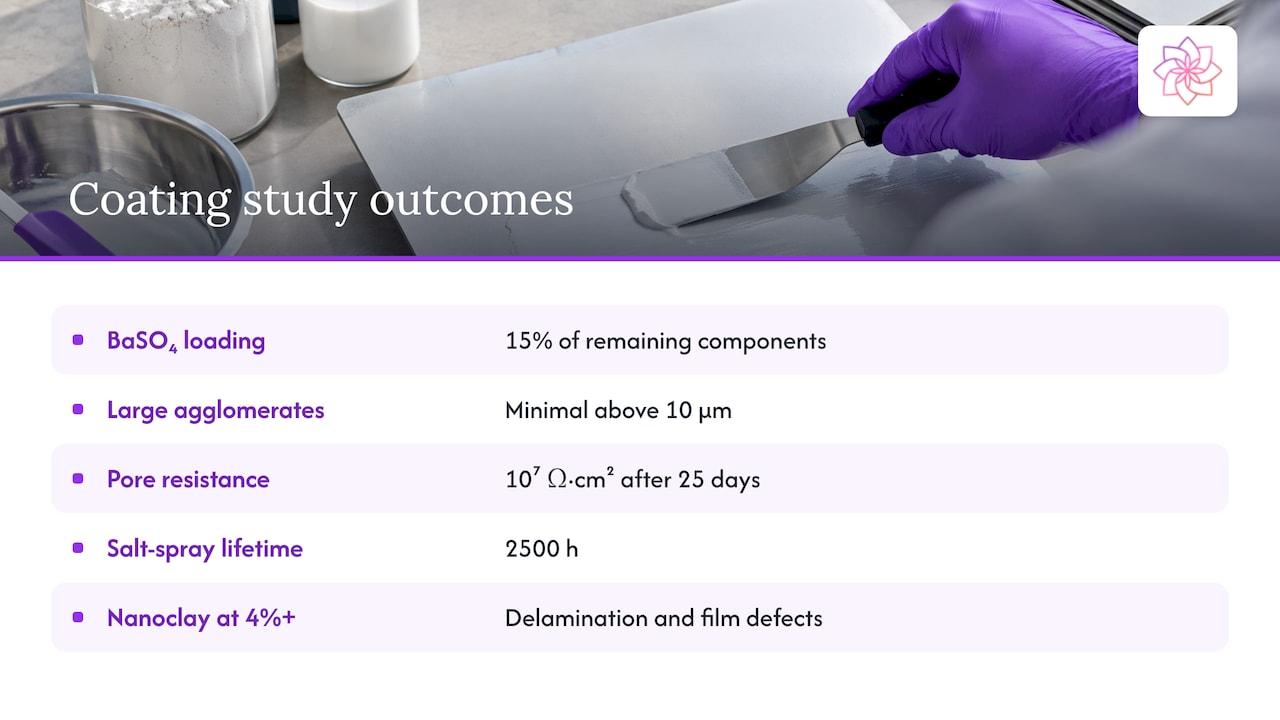
The formulation lesson is that barrier performance follows dispersion quality: uniform particle distribution without large agglomerates matters more than the nominal filler loading. Applicators see the same relationship in production, where polyester powder coating results on heavy or complex metal parts depend on uniform, defect-free film formation.
Quality checks worth building into the routine
- Fineness of grind at the end of the millbase stage and again after let-down.
- Particle size distribution by laser diffraction on a diluted sample, with attention to the upper tail (the D90 and D99 values), since a few large agglomerates cause most visible defects.
- Viscosity at several shear rates on day one and after storage, to see both the dispersion state and the structure.
- Gloss and film appearance on drawdowns at constant film thickness.
- Accelerated storage at elevated temperature, with settling and syneresis inspected visually and by probe.
- Incoming lot record of moisture, particle size and the date of manufacture.
These checks give the technical team a dataset that supports a lot-to-lot comparison and shortens qualification when a filler grade or additive changes.
Perspective
Barium sulfate dispersion fails most often at the interface between steps, not within one. A millbase that is well deagglomerated but poorly stabilized re-agglomerates in the can. A well-stabilized millbase with no rheology structure settles. A formulation with both but excess foam has defects that look like dispersion faults.
For this reason we develop dispersants, defoamers and rheology modifiers as a system and support them with laboratory-backed qualification. Our approach is to work from the customer's own binder, filler grade and process, determine the dosage on that system, and document it so that it transfers from the laboratory to production batches.
Our positioning is that comparable performance to premium additive brands can be achieved at a lower total cost-in-use, through optimized dosage, batch consistency and complete technical documentation. Formulators who qualify additives against production data find that the dosage ladder and the storage study are where that comparison becomes concrete.
Astra R&D Team
Qualifying an additive package with Astra Chemical
Astra Chemical manufactures and supplies dispersants (ASTRA DISP®), rheology modifiers (ASTRA REO®), silicone and non-silicone defoamers (ASTRA DF®, ASTRA DF NS®) and further functional coating additives for coatings, adhesives, inks, plastics and composites. Supply is direct to manufacturers, supported by technical consultations and sample requests.

Formulators working on a barium sulfate millbase can review the full range on the Astra Chemical product page, and further technical guides are published on the coating additives blog. To begin a qualification, send the filler grade, binder system and target properties with a sample request.
FAQ
Why does barium sulfate settle so quickly in a paint or adhesive?
BaSO4 has a high density compared with organic binders, so gravity acts on it strongly. Even in waterborne epoxy coatings it is difficult to keep suspended in the can. A stable dispersion plus a rheology structure with high low-shear viscosity holds the filler in place.
Is a dispersant enough, or is a mechanical step always required?
Both are required. Wetting and dispersing additives stabilize particles, but they do not by themselves break the hard agglomerates formed by moisture and salt bridges. High-intensity mechanical energy provides the separation, and the additive keeps the separated particles apart.
How do I find the right dispersant dosage?
Run a ladder study on the actual system: the same millbase at increasing additive levels, with viscosity measured after a fixed grind time. The best dosage is at the minimum or plateau of the viscosity curve. Repeat the study when the filler grade, lot or resin changes. Astra Chemical offers technical support and sample requests for this work.
Does surface treatment of barium sulfate remove the need for a dispersant?
Surface treatments such as silica, alumina or silane coatings improve dispersibility, as described in US Patent 4,551,497. The treated particle is easier to wet and stabilize, and a dispersant matched to the binder still sets the final fineness and storage stability.
How can I tell whether a dispersion will remain stable in storage?
Compare fineness of grind, viscosity profile and gloss on day one with the same measurements after heat-aged and room-temperature storage. A rise in viscosity or a drop in gloss indicates re-agglomeration, while a hard layer at the bottom of the can indicates insufficient suspension structure.
Sources
- Waterborne Epoxy Protective Coatings, Journal of Coatings Technology (2002)
- What Causes the Agglomeration of Barium Sulfate Powder and How to Disperse It (2026)
- Hardenable materials containing disagglomerated barium sulfate (patent application, 2007)
- European Patent EP 2,871,209 B1, Barium sulfate composite particles (2018)
- US Patent 4,551,497, Method of producing surface-treated barium sulfate (1985)
- Process for the production of a storage-stable barium sulphate (patent)
- Synergistic Effect of Nanoclay and Barium Sulfate Fillers, Coatings (MDPI, 2023)
Testing additives for this application?
Send us your current formulation challenge and our technical team will recommend an ASTRA product package for lab screening.