Defoamer Dosage in Coatings and Adhesives: A Formulator's Guide
Defoamer Dosage in Coatings and Adhesives: A Formulator's Guide ! Test vessels show foam levels across defoamer doses Defoamer dosage is not a single number on a data sheet.
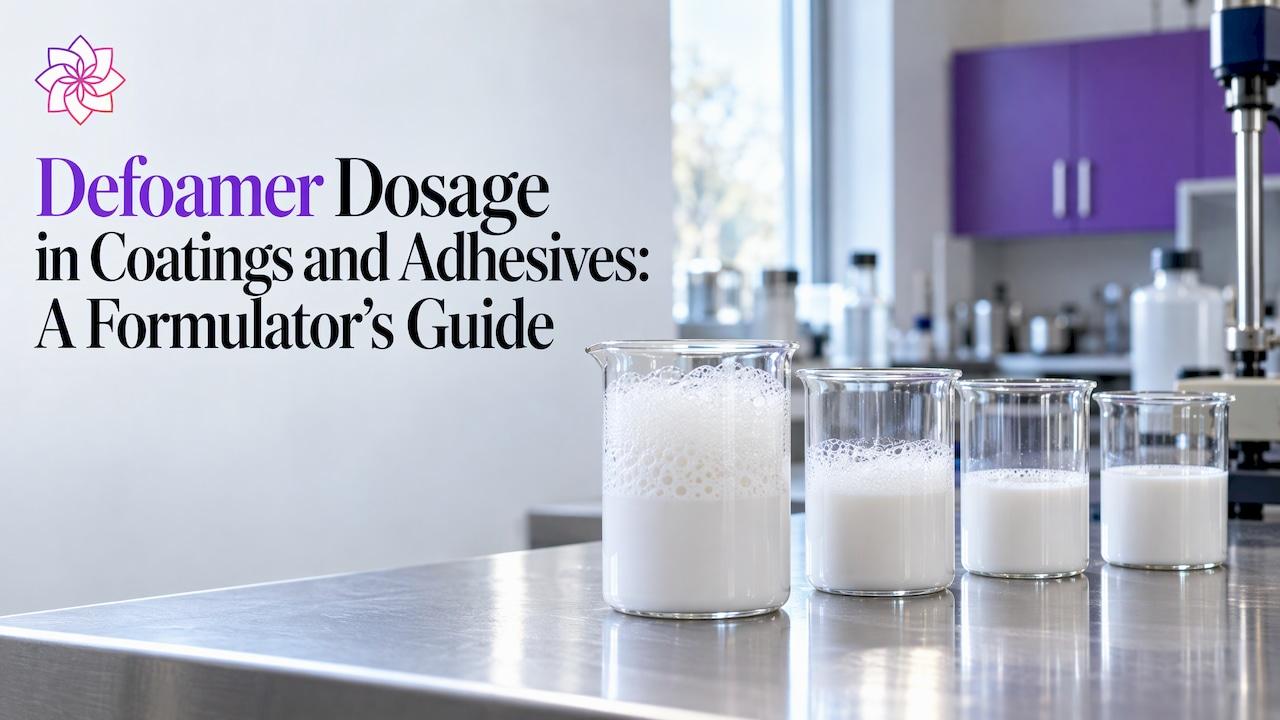
Defoamer dosage is not a single number on a data sheet. It is the lowest level that controls foam and entrained air in a specific formulation, under specific shear, at a specific stage of production, without causing craters, fisheyes, haze or recoat problems. Published ranges for waterborne systems sit in the low tenths of a percent on binder or total formulation, but the working figure is always established by a dose ladder on the actual system. ASTRA DF® (silicone) and ASTRA DF NS® (non-silicone) are supplied with technical support for exactly this qualification step, so that the dose is set on laboratory data rather than on a guess carried over from another product.
TL;DR
- Start from the supplier's recommended range and run a ladder of three to five levels. Select the lowest dose that meets the foam, air-release and film-appearance criteria together.
- Patent literature on defoamer-containing formulations describes 0.05 to 1 weight percent based on binder as a preferred concentration range. Treat it as a screening window, not a specification.
- Viscosity, surfactant and pigment load, shear, temperature and the stage of addition (grind, letdown, post-add) move the optimum more than any nominal figure.
- Underdosing leaves foam, pinholes and voids. Overdosing produces craters, fisheyes, gloss loss and poor recoatability. The window between them is narrowest in clear and low-viscosity systems.
- Splitting the dose between grind and letdown frequently gives better balance than a single addition, provided each portion is validated.
Dosage is expressed as a percentage of total formulation weight, as a percentage on binder or resin solids, or in ppm for process water and fermentation-type applications. Before comparing any two recommendations, confirm the basis. A figure of 0.3% on total formulation and 0.3% on binder solids differ materially in a paint at 40% solids, and the difference grows in pigmented high-solids systems.
The objective also differs by application:
- Defoaming removes foam that has already formed, typically at the surface of a mill base, a letdown tank or a filling line.
- Antifoaming prevents foam from forming during mixing, pumping and application.
- Deaeration releases micro-bubbles entrained in the bulk, which matters for clear coatings, adhesive bond lines and thick films where bubbles survive as pinholes or voids.
A defoamer that excels at breaking surface macrofoam may be weak at releasing micro-foam. The dose that satisfies one criterion is therefore not automatically the dose that satisfies the others, and the test method has to measure the property the application actually requires.
Typical starting ranges
Starting ranges are useful only as the first rung of a ladder. The table summarizes the ranges formulators commonly screen. Product-specific limits always come from the technical data sheet of the grade selected.
| System | Common screening range | Basis | Main risk at the upper end |
|---|---|---|---|
| Low-viscosity waterborne paint and primer | 0.05% to 0.3% | Total formulation | Craters, fisheyes |
| Pigmented waterborne architectural or industrial coating | 0.1% to 0.5% | Total formulation | Gloss loss, haze, recoat defects |
| Waterborne acrylic and PSA adhesives | 0.05% to 0.5% | Wet adhesive | Reduced wetting, bond-line defects |
| Inks (water-based) | 0.1% to 0.5% | Total formulation | Dewetting, print-quality loss |
| Resin or emulsion synthesis, process water | 2 to 50 ppm or higher | Process stream | Deposits, downstream foam |
These bands are consistent with the 0.05 to 1 weight percent on binder described in patent literature, and with the 0.5% level used as a standard challenge dose in the shaker and dissolver test methods published by the American Coatings Association's technical community. A deliberately high test level reveals efficiency differences between grades quickly. It is not the level at which a product should be run in production.
What shifts the optimum dose
Viscosity and rheology
High viscosity slows bubble rise and traps air, so thick systems often need better deaeration, not necessarily more defoamer. Low-viscosity systems release bubbles quickly but are more prone to craters when the defoamer is incompatible, so the window is narrow and the dose should stay small. Associative thickeners and rheology modifiers also interact with defoamer droplets. Changing the rheology package normally calls for re-checking the dose.
Surfactants, wetting agents and dispersants
Surfactant level is the dominant source of foam in waterborne systems. A formulation with a high load of wetting agent or dispersant generates more foam and may consume defoamer by emulsifying or solubilizing it. When a dispersant is changed or its level adjusted, the defoamer dose should be treated as an open variable. Pairing a dispersant such as ASTRA DISP® with a defoamer from the same supplier lets both be qualified in the same laboratory program.
Pigment and filler load
High pigment volume concentration increases the air carried into the mill base and raises the foam load during grind. Fine fillers can also adsorb defoamer actives, lowering the effective concentration in the continuous phase. This is a common reason that a dose proven in a clear or lightly pigmented prototype underperforms in the production color.
Shear and process equipment
High-speed dissolvers, bead mills, in-line mixers, pumps and airless spray equipment each introduce air differently. A formulation that is stable in a laboratory shaker may foam in a vacuum-free production mixer with a deep vortex. Shear also governs how finely the defoamer is dispersed: droplets that are too coarse cause surface defects, and droplets that are too fine can be ineffective.
Temperature, pH and storage
Temperature changes the solubility and spreading behavior of defoamer actives. Some products lose efficiency after storage because the defoamer is gradually emulsified into the system. A dose should therefore be checked on fresh material and again after aging, typically after a period at elevated temperature that represents expected shelf life.
Chemistry of the defoamer
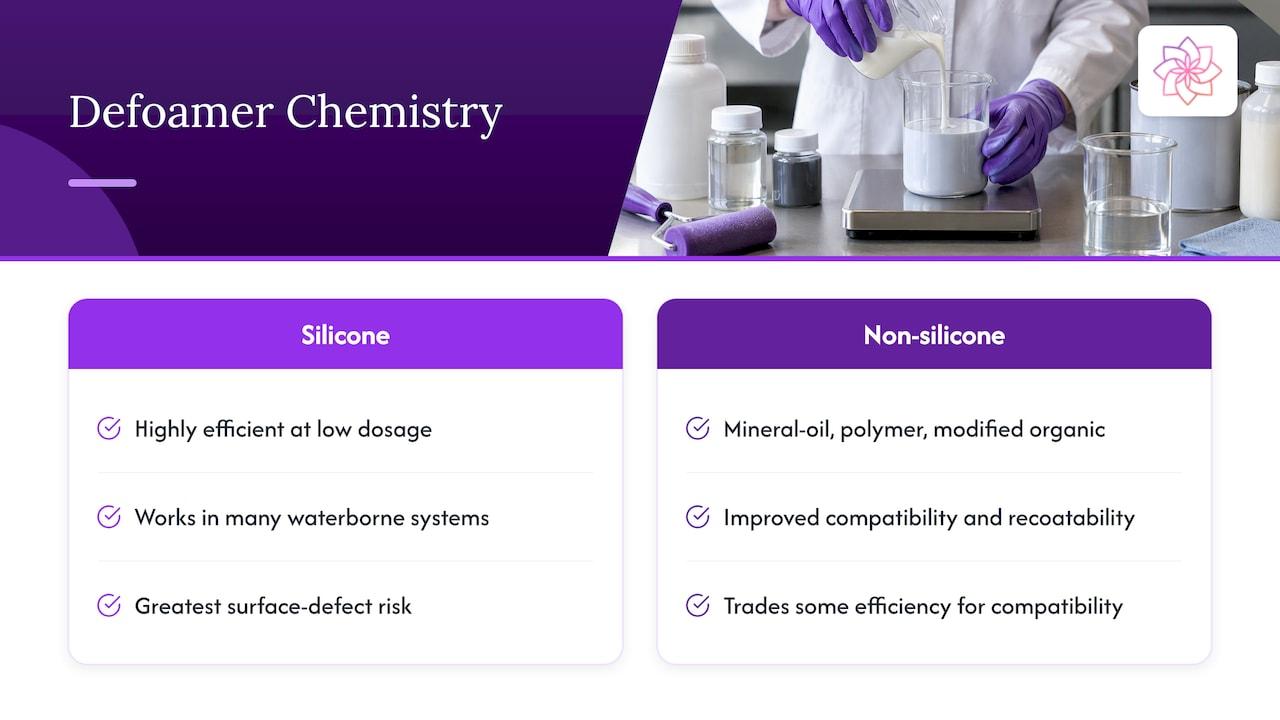
Silicone defoamers are highly efficient at low dosage and work well in many waterborne systems, but they carry the greatest risk of surface defects where recoat adhesion or clean surface energy matters. Non-silicone grades (mineral-oil, polymer-based or modified organic chemistries) typically trade some efficiency for improved compatibility and recoatability. ASTRA DF® and ASTRA DF NS® cover both routes, so the selection can be made on the performance requirement of the system rather than on availability.
Timing: grind, letdown and staged addition
Where the defoamer enters the process affects both the dose needed and the defect risk.
- Grind stage. Foam during dispersion reduces mill efficiency and entrains air. A defoamer added here is exposed to high shear and is dispersed into fine droplets, which is why a stronger, less compatible defoamer is more tolerable in the grind than in the finished paint. Part of it is lost to adsorption on pigment surfaces.
- Letdown stage. Added with the binder and additives under lower shear, the defoamer protects against foam during blending, filtering and filling. It is the stage that most directly determines the in-can and in-film result, so compatibility matters most here.
- Post-addition. A small correction after viscosity and color adjustment, or immediately before filling, can resolve residual foam without re-dosing the whole batch. The quantity should be recorded and capped, because corrective additions accumulate over repeated batches.
A common practice is to split the total dose, for example between grind and letdown, so that each stage receives the amount needed to control its own foam. The split ratio is not universal. It should be determined by testing the two extremes (everything in grind, everything in letdown) and then an intermediate split, evaluating foam during processing and film appearance after application.
Staged addition is not a way to overcome an incompatible defoamer. If craters appear at a total dose that is already low, the grade or chemistry is the problem, and the correction is to change the product rather than the split.
Underdosing and overdosing
| Condition | Typical symptoms | Usual first correction |
|---|---|---|
| Underdosed | Persistent surface foam, low density in the can, pinholes and micro-foam in the dried film, slow filling | Increase dose by small increments, or move part of the dose to the stage where the foam appears |
| Overdosed | Craters, fisheyes, dewetting, gloss reduction, haze in clear films, poor intercoat adhesion, in some cases renewed foam | Reduce dose, check dispersion quality, or change to a more compatible grade |
| Poorly dispersed | Isolated craters at a dose that should be safe, inconsistent results between batches | Increase shear at addition or pre-dilute under controlled conditions |
The asymmetry between the two failures drives the practice of using the lowest effective dose. Foam can be fixed in the plant, but craters in a cured film usually mean rework or scrap. For this reason, dosing decisions should weigh film appearance at least as heavily as foam height.
How to test and optimize dosage
Step 1: Define the pass criteria
Before touching a pipette, write down what constitutes success: maximum foam volume after a defined agitation time, target density or air content, time to foam collapse, and film appearance on the real substrate. Each criterion needs a numerical or visual rating scale so that results are comparable between operators.
Step 2: Screen with a standard challenge
The published defoaming test methods describe shaker and dissolver procedures using 150 g of paint at 0.5% defoamer, with foam quantified by the decrease in density compared with the control. This approach ranks candidates quickly. Run the control without defoamer, then each candidate at the same level and under the same time, speed and vessel geometry.
Step 3: Build a dose ladder
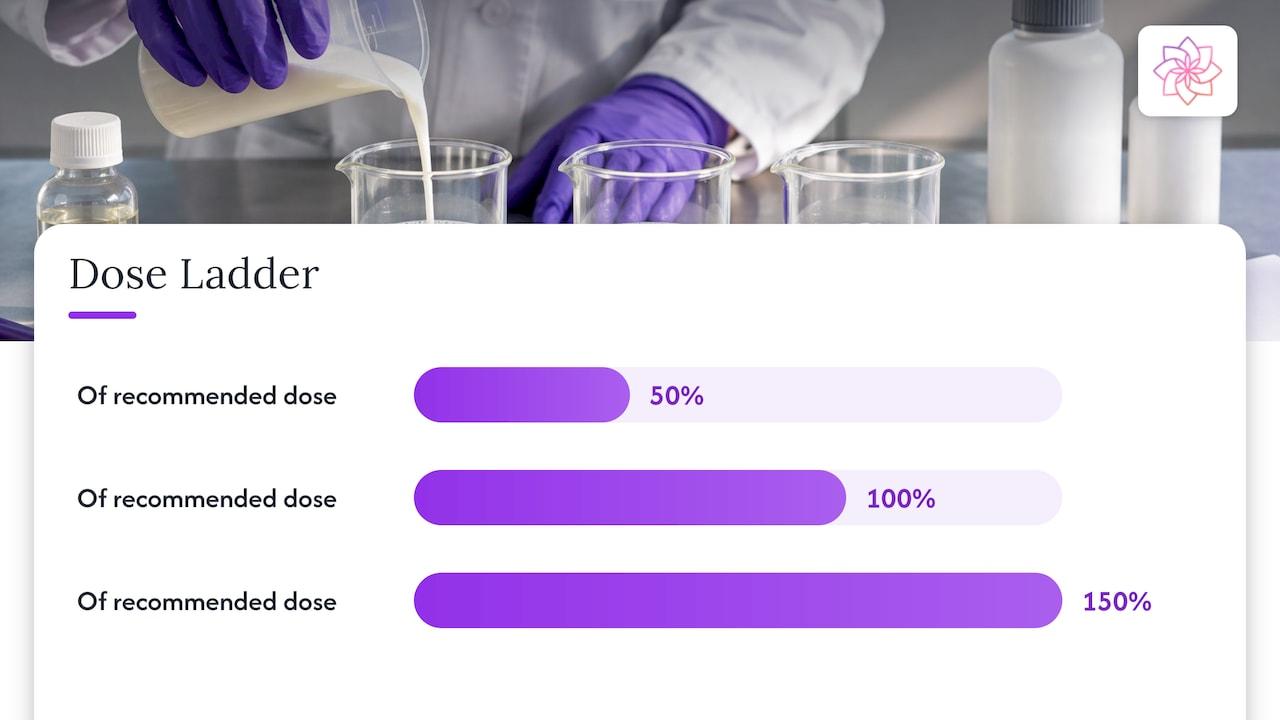
Take the one or two best candidates and prepare a ladder of three to five dose levels bracketing the supplier's recommendation, for example at 50%, 100% and 150% of the recommended level, with an extra rung either side if the response is steep. Measure foam, density or air content, and then apply each level to the intended substrate for film appearance. Use black or glossy panels for craters and a clear film or a vertical drawdown for pinholes. For adhesives, evaluate the bond line and, where relevant, laminate clarity.
Step 4: Check stability and compatibility
Repeat the lead dose after storage at elevated temperature and after a freeze-thaw cycle where the product is exposed to it. Confirm that gloss, color acceptance, viscosity stability and recoat or intercoat adhesion remain within specification. A dose that is excellent on day one and fails after four weeks is not a valid dose.
Step 5: Scale up
Laboratory shear rarely matches production. Run a pilot batch with the mixing equipment and addition point of the plant, and adjust the dose to the observed foam behavior. Record order of addition, dilution of the defoamer, mixing time after addition and temperature, because these determine reproducibility. Keeping these records in a structured system, such as manufacturing quality control software, makes batch-to-batch trends visible and shows whether a drift in foam behavior follows a change in raw-material lot.
Step 6: Lock the window
Set a nominal dose with a permitted range, and define the corrective action when foam appears outside the window. Operators should know whether the first response is a small post-addition, a longer mixing time or a hold for the laboratory.
Cost-in-use rather than price per kilogram
The cheapest defoamer per kilogram is not necessarily the cheapest per tonne of finished product. A more efficient grade used at half the dose can cost less in use, and a more compatible grade can eliminate rework. Evaluate cost-in-use as the dose required to meet all criteria multiplied by the price, plus the cost of defects and extra process steps. ASTRA Chemical positions its range around comparable performance to premium brands at a lower total cost-in-use, with optimized dosage support, batch consistency and documentation for regulatory and production needs.
Perspective
Dosage problems are rarely solved by the defoamer alone. In our laboratory work, the effective dose depends on the interaction between the defoamer, the dispersant, the rheology package and the process, which is why we treat them as one system rather than as separate purchases.
Our approach is to qualify the defoamer against the criteria of the customer's own formulation: foam control, air release, film appearance and recoatability. Silicone and non-silicone grades each have a place, and we supply both (ASTRA DF® and ASTRA DF NS®) so that the choice follows the requirement. We design our products and technical support to find the lowest effective dose, because a lower dose reduces both cost-in-use and the risk of surface defects.
Batch consistency matters as much as the initial dose. A dose window established on one lot is only useful if the next lot behaves the same way, and we manufacture with that continuity in mind.
Astra R&D Team
Qualifying a dose with ASTRA Chemical
ASTRA Chemical manufactures dispersants, silicone and non-silicone defoamers, rheology modifiers and functional additives for coatings, adhesives, inks, plastics and composites, supported by technical consultations and sample requests. A formulator can request samples of ASTRA DF® or ASTRA DF NS® and run the ladder described above on the production formulation, with dosage guidance from the technical team. Full grade information is on the ASTRA product range page, and dispersant details are on the ASTRA DISP® page.
For custom formulation guidance, laboratory-backed qualification and batch documentation, the starting point is the ASTRA Chemical website.
FAQ
What is a typical defoamer dosage for waterborne coatings?
Screening ranges generally fall between 0.05% and 0.5% of the total formulation, and patent literature describes 0.05 to 1 weight percent on binder. The right level depends on viscosity, surfactant load, pigment content and process shear. Confirm it with a dose ladder on the actual formulation.
Is it better to add defoamer in the grind or in the letdown?
Neither is universally better. The grind needs a defoamer that tolerates high shear and controls foam during dispersion, while the letdown determines the finished appearance and needs good compatibility. Many formulators split the dose between the two stages and validate the ratio by testing both extremes and an intermediate split.
What happens if too much defoamer is added?
Overdosing typically causes craters, fisheyes, dewetting, gloss loss and poor recoat or intercoat adhesion. Reducing the dose, improving dispersion at the addition point or moving to a more compatible grade usually corrects it. This is why the lowest effective dose is the target.
How is defoamer efficiency measured in the laboratory?
A common approach shakes or dissolves a fixed quantity of paint with a set defoamer level and compares density or foam volume with an untreated control, as described in the published defoaming test methods. Film appearance on the real substrate is then assessed separately, because foam control alone does not show compatibility.
Sources
Testing additives for this application?
Send us your current formulation challenge and our technical team will recommend an ASTRA product package for lab screening.