Biobased Dispersants: Selection, Testing and Qualification
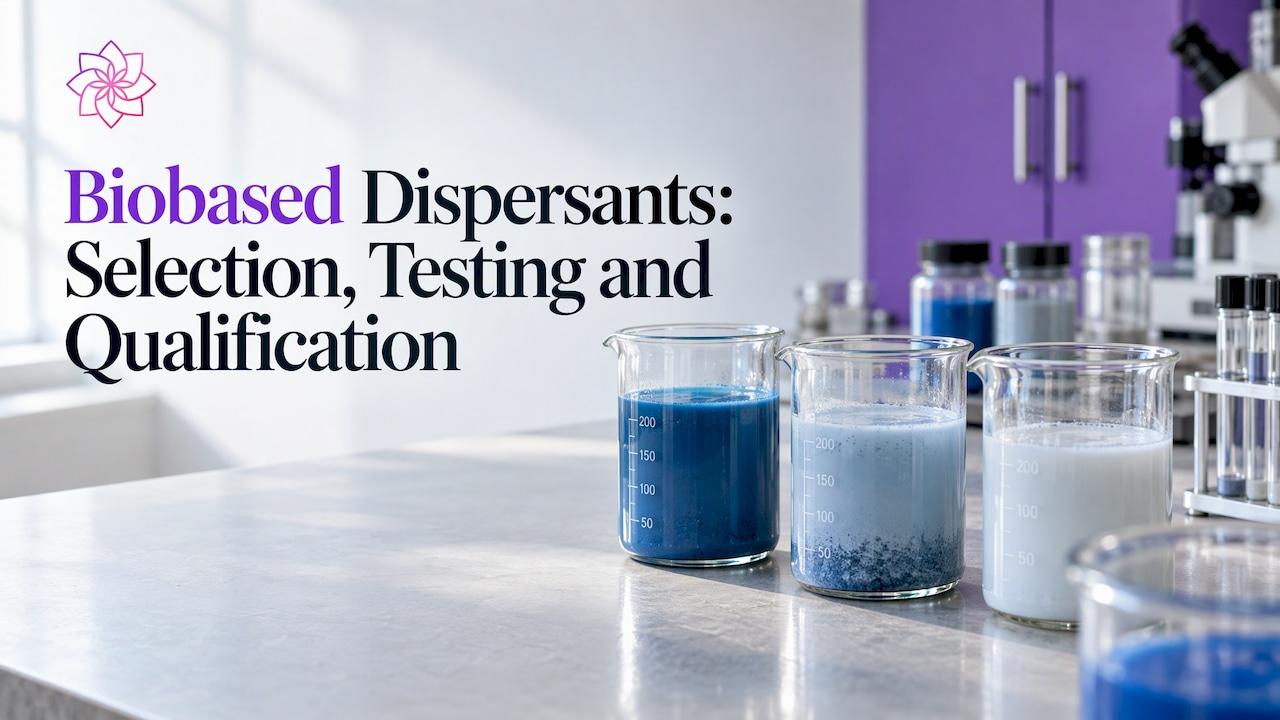
Biobased Dispersants: Selection, Testing and Qualification ! Pigment dispersion samples in a coatings laboratory Biobased dispersants are additives built on renewable-carbon chemistries that stabilize pigment and filler particles in coatings, adhesives and inks.
Biobased dispersants are additives built on renewable-carbon chemistries that stabilize pigment and filler particles in coatings, adhesives and inks. They are not drop-in copies of fossil-based grades, so a formulator gets reliable results only by qualifying each candidate against the specific binder, pigment and process. That qualification work, covering dose-finding, compatibility, storage stability and film performance, is where laboratory-backed technical support from an additive manufacturer such as Astra Chemical shortens the path from sample to approved formulation.
TL;DR
- Biobased dispersants rely on different chemistries than fossil-based ones and cannot be swapped 1:1, so every substitution is a re-qualification, not a line-item change.
- "Biodegradable" has a defined meaning: passing a ready biodegradability test such as OECD 301 within its pass levels and 10-day window.
- Binder compatibility decides the outcome. In one published latex study, scrub resistance rose sharply with two binders while a third system failed storage stability.
- Low-VOC selection starts with four questions: water- or solvent-based, organic or inorganic pigment, resin-free or resin-containing grind, and which binder family.
- Defoamers need the same discipline: screen efficiency, compatibility, gloss, persistence and storage stability before scale-up.
A dispersant does three jobs in a mill base: it wets the pigment or filler surface, helps break agglomerates under shear, and then stabilizes the separated particles so they do not flocculate again. In waterborne systems the stabilization is largely electrostatic or electrosteric. The additive adsorbs on the particle and builds a double electrical layer, so neighboring particles repel each other, the mechanism described by DLVO theory and summarized in a 2026 PCI Magazine review of bio-based dispersing additives.
"Biobased" describes where the carbon comes from, not how the molecule behaves. A dispersant can derive its backbone or hydrophobic segments from plant-based raw materials such as fatty acids, vegetable oils or sugars, and the renewable share can be verified through 14C analysis. The same PCI review lists the commonly cited advantages: a more environmentally friendly formulation, a smaller carbon footprint, support for sustainability requirements, in many cases a biocide-free composition, and easier Ecolabel certification of the finished paint.
The practical consequence for a formulator is stated plainly in that review: these additives are mostly based on different chemistries from conventional dispersants, so they cannot replace them on a one-to-one basis. Anchoring group, molecular weight, charge density and solubility all differ, and each shifts the optimum dose and the interaction with surfactants and binders.
Biodegradable versus biobased: two different claims
The two terms are frequently merged in search queries and on data sheets, yet they answer different questions.
| Claim | What it describes | How it is substantiated |
|---|---|---|
| Biobased | Origin of the carbon (renewable versus fossil) | Renewable carbon content, typically by 14C analysis |
| Biodegradable | Fate of the substance in the environment | Standardized ready biodegradability tests (OECD 301 series, 310, 306) |
| Low VOC | Volatile organic compound content of the additive or formulation | Method-based VOC determination under the applicable regulation |
A fully fossil-derived molecule can be readily biodegradable, and a plant-derived molecule can be persistent. Specifications should therefore request each claim separately and with its test basis.
What a ready biodegradability pass requires
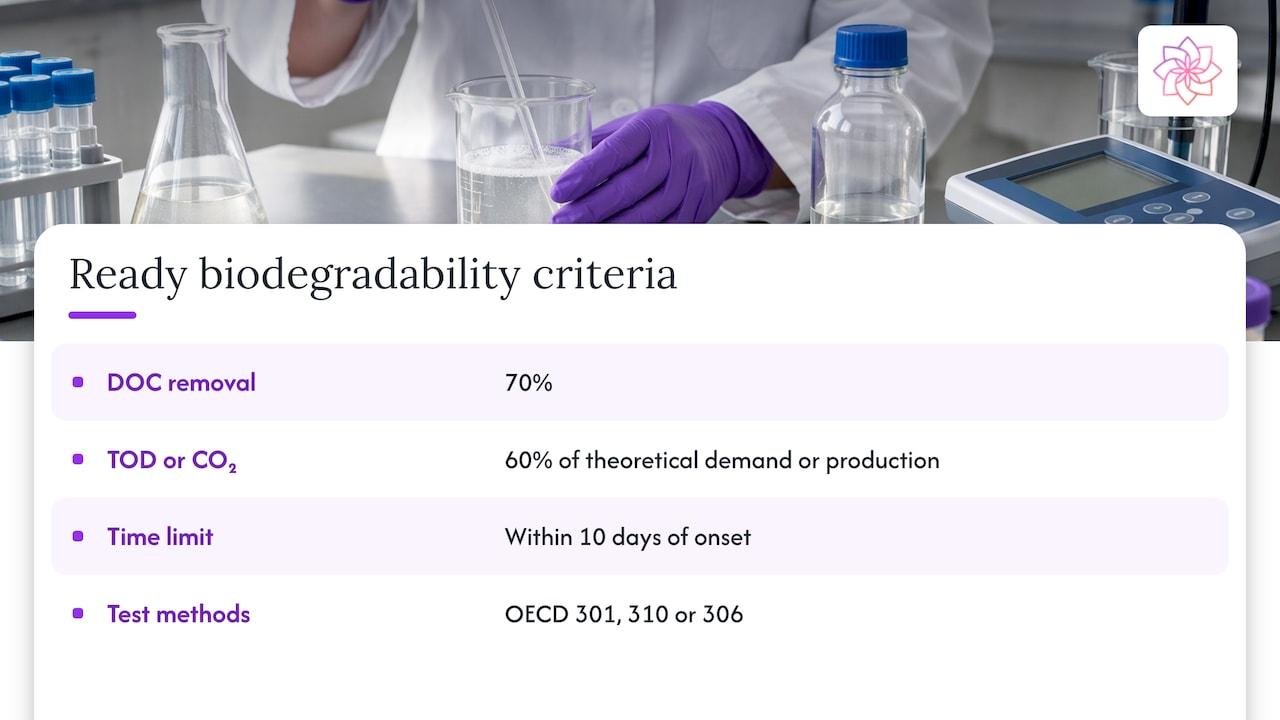
According to a 2023 peer-reviewed review of OECD and ISO biodegradability testing, a substance counts as readily biodegradable when it reaches sufficient biodegradation in one of the OECD 301 tests, OECD 310 or OECD 306. The pass levels are 70% dissolved organic carbon removal, or 60% of theoretical oxygen demand or carbon dioxide production, and that level has to be reached within 10 days of the onset of biodegradation. The same review notes that a positive result is generally accepted as meaningful for the labels "ready biodegradable" and "non-persistent".
In the United States, the EPA applies this logic to product claims in a specific regulatory setting. For an "all ingredients" biodegradability claim on a FIFRA-registered pesticide product, all surfactants must pass the Safer Choice Criteria for Surfactants screen and the other ingredients must pass a Ready Biodegradability Test. That criterion governs pesticide labeling, not coatings in general, but it shows the standard of evidence that an auditor or customer is likely to expect when a dispersant is described as biodegradable.
For procurement, the useful request is a test report that names the guideline (for example OECD 301B or 301F), the test substance and the pass level reached. A statement without that reference does not support a specification.
What changes in the formulation when a dispersant is bio-based
The 2026 PCI study is the most concrete public dataset on the question, using latex paints. Two findings frame the whole selection problem.
Performance can improve materially. With a styrene-acrylic binder, the bio-based dispersant delivered an almost 350% higher scrub resistance result than a fossil-based dispersant, and with a vinyl-VeoVa binder the improvement exceeded 100%.
Compatibility is binder-specific. In a pure acrylic emulsion, the same study found the dispersant interacted so strongly with surfactants and particles that the paint failed a 14-day storage stability test, with viscosity rising beyond what could be measured. The study's conclusion is that compatibility has to be tested with each binder system.
Taken together, these results show why a generic ranking of "best" dispersants has little value. The same additive can be the strongest option in one binder and unsuitable in another, and the difference only appears in a structured test series.
Variables that move the result
- Binder chemistry: pure acrylic, styrene-acrylic, vinyl acrylic and vinyl-VeoVa systems carry different surfactant packages and surface charges.
- Pigment type: organic pigments, titanium dioxide and extender grades demand different adsorption behavior.
- Grind type: resin-free grinds place the entire stabilization burden on the dispersant, while resin-containing grinds share it with the binder.
- Process energy: grinding energy and batch temperature influence adsorption and should be recorded alongside renewable content.
- Dose: over-dosing raises mill-base viscosity and can sensitize the film to water, while under-dosing leaves agglomerates that cost color strength.
How to select a low-VOC dispersant
Low-VOC targets have shaped architectural and industrial formulation for years, and dispersant choice sits upstream of many downstream problems. A PCI Magazine article on low-VOC architectural coatings reduces the first screen to three questions: is the system water-based or solvent-based, will the dispersed pigment be organic or inorganic, and will the grind be resin-free or resin-containing. The answers narrow the dispersant type before any laboratory work begins.
A workable selection sequence then looks like this:
- Define the system. Record binder family, pigment loading, target solids, pH and the surfactants already present.
- Set the claim requirements. Decide whether the specification needs a VOC limit, a renewable-carbon share, a biodegradability pass, an Ecolabel pathway, or a combination.
- Run a dose ladder. Determine the effective dose from mill-base viscosity and flow curves, the approach recommended in the 2026 PCI review.
- Test each binder. Measure viscosity drift and storage compatibility on the finished system, including accelerated heat aging.
- Compare film performance. Evaluate scrub resistance, washability and color acceptance before scale-up.
- Confirm at pilot scale. Check grinding energy and batch temperature, since lab-scale success does not always transfer.
This sequence is also the point at which a supplier's qualification support has the most value. Dose-finding and binder screening consume formulator hours, and a manufacturer that runs the same tests in its own laboratory and documents the outcome gives the formulator a shortlist rather than a catalog.
Bio-based defoamers: the same logic applies
The keyword cluster around biobased dispersants almost always includes defoamers, because foam control and pigment dispersion are coupled: high-shear grinding entrains air, and surfactant-rich dispersant packages stabilize it. Plant-derived carriers are one route for oil-based defoamers. A producer of pine-chemical solvents describes such oils as carriers that give the active ingredients a balance of compatibility and incompatibility, which is what allows foam to be prevented and destroyed. Effective foam control improves packaging consistency, protects equipment and reduces surface defects such as craters and pinholes.
Whatever the chemistry, defoamer evaluation follows a stable checklist. The PCI low-VOC article states that thorough screening must cover efficiency, compatibility with the formulation, gloss, persistence and storage stability. Selection criteria in the same source include:
- concentrates for incorporation into the grind, and emulsions or highly compatible concentrates for the letdown;
- compatibility with pure acrylic, vinyl acrylic and styrene-acrylic resins;
- impact at different pigment volume concentrations;
- incorporation under low shear.
The article's authors determined defoaming efficiency with a high-shear stir test chosen because it suits a wide range of viscosities and application methods, including spray, brush and roller. The lesson for any plant is to make the foam test resemble the real application, since a defoamer that performs in a low-shear bench test can behave differently under spray.
Silicone and non-silicone defoamers
Defoamer families split mainly into silicone and non-silicone (mineral-oil, polymer and vegetable-oil based) types. Silicone grades are highly efficient at low dose, while non-silicone grades are often chosen where surface-defect risk, recoatability or intercoat adhesion is a concern. The choice depends on the substrate, the application method and the downstream process, and it should be made with a paired test: foam knockdown and persistence on one side, crater formation and gloss on the other.
A comparison framework for dispersant candidates
When several candidates are on the bench, a scoring table keeps the decision traceable. The columns below are the ones that decided outcomes in the studies cited above.
| Criterion | What to measure | Decision signal |
|---|---|---|
| Dose efficiency | Mill-base viscosity versus dose | Lowest dose reaching the viscosity plateau |
| Binder compatibility | Viscosity drift over 14 days at ambient and elevated temperature | No unmeasurable rise, no syneresis or flocculation |
| Film performance | Scrub resistance, washability, gloss | Equal or better than the incumbent |
| Color development | Color acceptance, strength, rub-out | Within tint tolerance |
| Process fit | Grinding energy, batch temperature | Stable at plant conditions |
| Claim support | VOC data, 14C content, OECD test reference | Documents available for the specification |
Where Astra Chemical fits
Astra Chemical manufactures dispersants, silicone and non-silicone defoamers, rheology modifiers and functional coating additives for coatings, adhesives, inks, plastics and composites. Technical support and custom formulation guidance accompany the product lines, and sample requests are part of the commercial process. The offer is positioned around comparable performance to premium brands at lower total cost-in-use, optimized dosage support, batch consistency and laboratory-backed qualification, with documentation prepared for regulatory and production needs.
That combination matches the qualification steps above. Dose-finding, binder-by-binder compatibility checks and the documentation a specification requires are the activities where a supplier's laboratory removes work from the formulator's schedule. Batch consistency matters for the same reason: a dose ladder run on one lot is only useful if later lots behave identically.
Formulators who want to start from the product lines can review ASTRA DISP® pigment dispersants, the ASTRA DF® defoamer line and the ASTRA DF NS® non-silicone defoamers. The full range is on the Astra Chemical product overview, and the technical team handles sample requests and application questions for coatings, adhesives and inks.
When a project involves a sustainability target, the most efficient first message to a supplier states the binder, pigment, grind type, process and the exact claim the final product must support. Those four inputs allow a candidate list and a test plan to be drawn up before the first sample ships.
Perspective from our laboratory
Sustainability targets are now part of many dispersant briefs, and they arrive alongside the same performance demands as before: low mill-base viscosity, stable storage, clean color development and a film that survives its service life. We treat these as one qualification problem, not two. A renewable-carbon or biodegradability claim has value only if the additive also holds a pigment grind stable in the customer's own binder.
That is why our approach starts from the formulation, not the catalog. We ask for the binder, the pigment, the grind type and the process, then work through dose, compatibility and storage behavior in the laboratory, and document the result so that procurement and regulatory teams can use it. Our dispersants, defoamers and rheology modifiers are designed to be qualified this way, and our focus on batch consistency means the result obtained on a sample can be carried into production.
For customers weighing cost, we look at cost-in-use rather than price per kilogram: the dose needed, the defects avoided and the reformulation effort saved. A well-matched dispersant and defoamer pair reduces rework and supports a longer-lasting finished product, and that is where we aim to deliver the most value.
Astra R&D Team
Specification checklist for sustainable dispersants
Before a purchase request is issued, a technical director or procurement manager can verify that the request covers the following items:
- The claim is split into origin (biobased content), fate (biodegradability) and emissions (VOC), each with its own evidence.
- Biodegradability references name the test guideline and the pass level reached.
- The binder families and pigment types of every intended product are listed.
- Acceptance criteria are written in advance: viscosity drift limit, scrub resistance target, color tolerance, foam level.
- Sample quantity is sufficient for a dose ladder and an accelerated storage study.
- Batch-to-batch consistency and documentation expectations are stated for the supply agreement.
A request that contains these items gets a more precise answer from any supplier and prevents the common outcome in which a sample passes a screening test and then fails in a binder that was never mentioned.
FAQ
Can a biobased dispersant replace my current dispersant at the same dose?
Not as a rule. Bio-based dispersants are mostly built on different chemistries, so the optimum dose, viscosity profile and surfactant interaction usually differ from the incumbent. Plan a dose ladder and a binder-specific storage study for every substitution.
What makes a dispersant readily biodegradable?
It must pass a ready biodegradability test such as one of the OECD 301 methods, reaching 70% dissolved organic carbon removal or 60% of theoretical oxygen demand or carbon dioxide production, within a 10-day window after biodegradation begins. Ask for the guideline and result, not only the label.
Which tests should a low-VOC dispersant pass before scale-up?
Determine the effective dose from mill-base viscosity and flow, then check viscosity drift and storage compatibility in each binder. Compare scrub resistance, washability and color acceptance against the current formulation, and confirm grinding energy and batch temperature at pilot scale.
How should I screen a defoamer for a water-based coating?
Test efficiency, compatibility with the formulation, gloss, persistence and storage stability. Use a foam test that resembles your application method, and check compatibility with your resin family, whether pure acrylic, vinyl acrylic or styrene-acrylic.
What information does a supplier need to recommend a dispersant?
The binder type, pigment or filler, grind type (resin-free or resin-containing), water- or solvent-based system, process conditions and the specific claim required of the finished product. With these, a candidate list and a test plan can be set up quickly.
Sources
- Challenges in Selecting Bio-Based Dispersing Additives for Latex Paints, PCI Magazine
- Optimizing Low-VOC Architectural Coatings Through Additive Technology, PCI Magazine
- Toward the future of OECD/ISO biodegradability testing, PMC
- Criteria for Biodegradability Claims on Products Registered under FIFRA, US EPA
- SYLVASOLV Biobased Chemicals for Industrial Applications
Testing additives for this application?
Send us your current formulation challenge and our technical team will recommend an ASTRA product package for lab screening.