Adhesion Promoter Additives: Types, Mechanisms and Selection
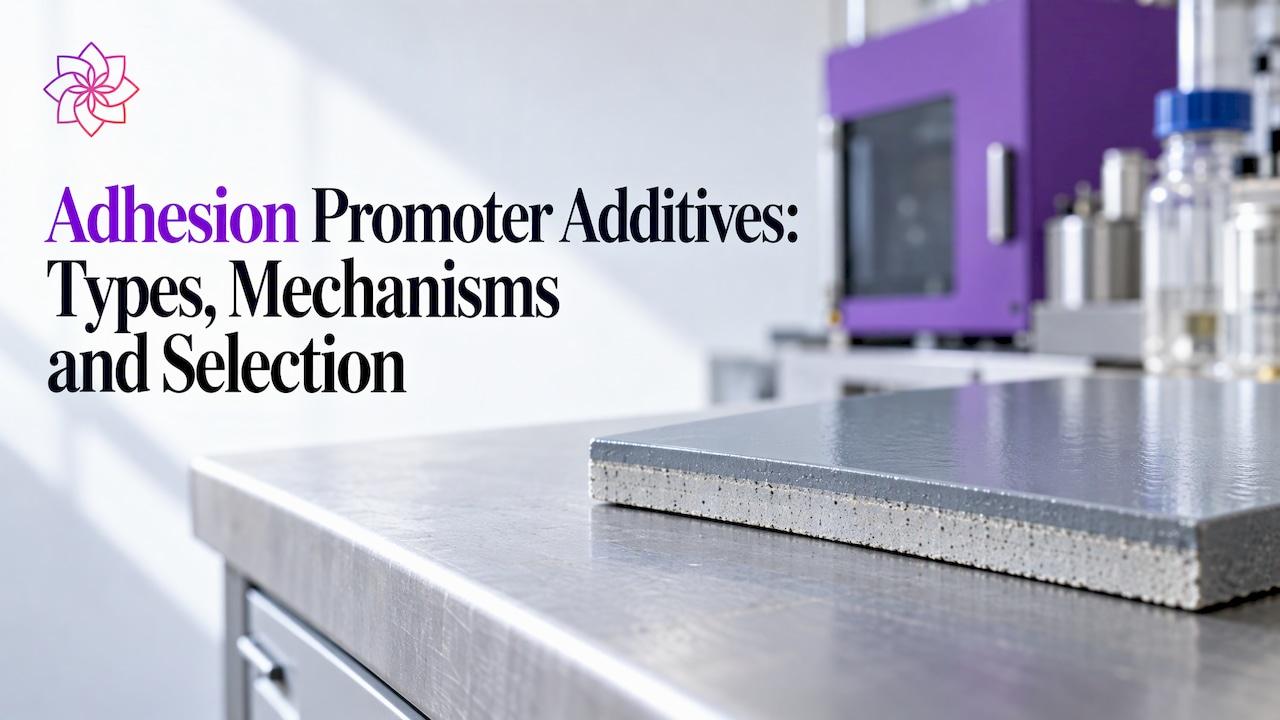
Adhesion Promoter Additives: Types, Mechanisms and Selection ! Coated polymer coupon showing its layered interface Adhesion promoter additives are bifunctional or interface-active materials that strengthen the bond between a coating, ink, adhesive or sealant and a substrate that would not otherwise…
Adhesion promoter additives are bifunctional or interface-active materials that strengthen the bond between a coating, ink, adhesive or sealant and a substrate that would not otherwise bond well. They are chemical additives that join two dissimilar materials, typically an organic polymer and an inorganic substrate, by forming covalent or hydrogen bonds, or by modifying the interface so the liquid film wets and anchors properly. Selection depends on the substrate, the resin chemistry, the solvent or water carrier, and the way adhesion is measured. This guide covers each of those variables for formulators and technical buyers.
TL;DR
- An adhesion promoter is either an internal additive blended into the formulation or a surface treatment (primer or tie-coat) applied to the substrate first. The two are related but not interchangeable.
- The main chemistries are silanes, titanates, zirconates, acid-modified or hydroxyl-functional monomers, and polymeric types such as chlorinated polyolefin (CPO) for low-energy plastics.
- Performance is a system property: promoter, solvent, substrate and topcoat act together, so qualification must be run on the real combination.
- Wetting and dispersion additives support adhesion by letting the film contact the substrate fully, but they do not replace a true coupling chemistry on difficult surfaces.
- Evaluate with a test method that reflects the failure mode, and record cohesive versus adhesive failure, not only a number.
A coating adheres when three conditions are met: the liquid wets the substrate, the interface develops sufficient secondary or primary bonding, and the cured film does not build internal stress that exceeds that bond. Adhesion promoters act on the first two. A materials science review notes that where a surface is wetted (contact angle below 90°), adhesion forces can exceed cohesive forces and the liquid can spread, while low-energy or contaminated surfaces lead to dewetting. Polyolefins, fluoropolymers, passivated metals and contaminated surfaces fall in the second group, which is why they need chemical help.
Mechanistically, a bifunctional promoter has one end that interacts with the substrate (hydroxyl groups, metal oxides, polymer chains) and one end that reacts or entangles with the resin. This produces what is often described as a chemical bridge. Adhesion promoters are described as specialty bifunctional compounds that can be used as internal additives or as surface treatments applied before the adhesive or sealant. Some are also used to bond the resin matrix to internal fillers and pigments, which improves film integrity as well as substrate bonding.
Where they are used
In the United States, adhesion promoters are widely used in automotive coatings, aerospace materials, electronics, construction sealants, packaging and industrial maintenance coatings, where durability, corrosion resistance and regulatory compliance drive specification. Market analysts forecast a 6.45% CAGR for adhesion promoters from 2026 to 2031, the fastest growth among chemical types in surface modification, led by difficult-to-bond polymers in body panels, electronics housings and structural assemblies.
In adhesives, acid-modified or hydroxyl-functional monomers are common promoters that can raise adhesion while lowering viscosity, and they are most often found in laminating adhesives. In coatings and inks the same function is delivered by silanes, metal-organic coupling agents or polymeric resins, depending on the substrate.
Types of adhesion promoter additives and how they differ
The chemistry decides which substrates a promoter serves and how it must be handled in the formulation.
| Type | Typical mechanism | Typical substrates | Formulation considerations |
|---|---|---|---|
| Silane coupling agents | Alkoxy groups hydrolyze to silanols, bond to hydroxylated surfaces and condense into a siloxane network; organofunctional group reacts with the resin | Glass, aluminum, steel, mineral fillers | Match the organofunctional group (amino, epoxy, mercapto, vinyl) to the resin; control moisture and pot life |
| Titanates and zirconates | Bond to metal oxides and surface hydroxyls; can also modify filler surfaces | Metals, pigments, fillers | Sensitive to water and to some acidic or amine components; check color and stability |
| Acid-modified and hydroxyl-functional monomers | Polar groups interact with the substrate while reactive groups join the network | Metals, glass, some plastics | Often used in laminating and reactive adhesive systems; dosage influences viscosity |
| Phosphate esters | Acid functionality interacts with metal surfaces | Ferrous and non-ferrous metals | Can affect water sensitivity and cure of some systems |
| Chlorinated polyolefin (CPO) and other polymeric promoters | Polymer chains penetrate and entangle with a low-energy plastic surface; polar groups anchor the topcoat | Polypropylene, TPO, other polyolefins | Solvent selection is critical; usually applied as a thin tie-coat |
Silane, titanate and zirconate promoters act through chemical interaction with both surfaces, while polymeric types such as maleated polymers and block copolymers rely largely on physical anchoring and compatibility. In practice many production formulations combine a coupling agent for metal or glass with a polymeric component for plastics.
Silanes in more detail
Silanes are the most widely used internal additive because they function at low loadings and are available in many organofunctionalities. The practical constraint is hydrolysis: a silane needs trace water to activate, yet premature condensation in a one-component system reduces its effect. Formulators therefore check storage stability at elevated temperature and confirm that the promoter is compatible with the neutralizing amine, catalyst or acid-functional resin in the system.
Polymeric promoters for low-energy plastics
Polyolefin substrates have no polar groups to bond with, so a polymeric tie-coat is applied to build a transition layer. A JCT paper on thermoplastic polyolefin (TPO) found that CPO type and solvent variation had the most significant effect on topcoat adhesion and cohesion among the factors evaluated. The same paper sets three roles for the solvent: it must dissolve the CPO to a low viscosity, penetrate deeply into the substrate (an aromatic 100 solvent penetrates much more deeply than xylene or a xylene/toluene blend), and evaporate at a rate that leaves no retained solvent keeping the cured part in a swollen state.
Adhesion promoter versus primer
The terms overlap in the field, and the distinction is about where the material sits and how it is applied.
- Adhesion promoter additive: blended into the coating, ink, adhesive or sealant at a low dosage. It migrates to the interface during application and cure. It adds no separate process step and no separate film.
- Adhesion promoter as surface treatment: a very thin film, often a solvent-borne polymer or silane solution, wiped, sprayed or dipped onto the substrate and flashed off before the topcoat. This is typical for polyolefin parts.
- Primer: a full coating layer with its own binder, pigment and film thickness. It is designed to bond to the substrate and to give the topcoat a compatible surface, and often also supplies corrosion protection, hiding or sealing.
The choice between them follows the process. If the production line already applies a primer, adding a coupling agent to the primer or topcoat is often the least disruptive change. If the substrate is a plastic that no standard primer wets, a dedicated tie-coat is the more reliable route. The same adhesion promoter materials are sold in both forms, which is why the vocabulary blurs.
Can an adhesion promoter be applied over existing paint?
It can be, but it is a recoating question rather than a general rule. Cured, aged, crosslinked films present a low-energy, sometimes contaminated surface, and adhesion of the next layer depends on the old film's chemistry and condition. The sequence that technical data sheets for coating systems generally follow is:
- Remove oils, waxes, silicone and other contaminants with a cleaner compatible with the existing film.
- Abrade the surface to create a mechanical key and remove chalking or degraded material.
- Confirm that the solvent of the promoter or topcoat does not lift or wrinkle the old film, using a small test area.
- Apply the promoter at the film thickness and flash-off time stated by its manufacturer, then recoat inside the stated window.
- Measure adhesion on the finished test panel before releasing the process.
Because the recoat window and the compatible film types are product-specific, the supplier's data sheet governs. A promoter is not a substitute for cleaning, and it does not correct a failing underlying film.
What determines success on a given substrate
Adhesion is rarely controlled by a single component. The JCT study concluded that effectiveness cannot be assigned to the CPO, the solvent, the substrate or the topcoat alone, but to the attributes of the system. The factors a formulation chemist should review are:
- Substrate surface energy and chemistry. Metals need oxide or hydroxyl bonding sites, plastics need either a polymeric tie-layer or surface activation, and glass benefits from silane coupling.
- Surface condition. Mold-release agents, slip additives, processing oils and handling residues create weak boundary layers that no additive overcomes.
- Resin compatibility. The reactive end of the promoter must match the binder: epoxy, polyurethane, acrylic, alkyd, or silyl-terminated systems each pair with different functionalities.
- Carrier system. Waterborne systems need hydrolytically stable or water-dispersible promoters, and solvent-borne systems depend on solvent penetration and retention.
- Cure schedule. Temperature and time influence interface reaction, residual solvent and internal stress.
- Other additives. Defoamers, dispersants, and rheology modifiers compete for the same interface and can either support or disturb adhesion.
Wetting agents, dispersants and defoamers
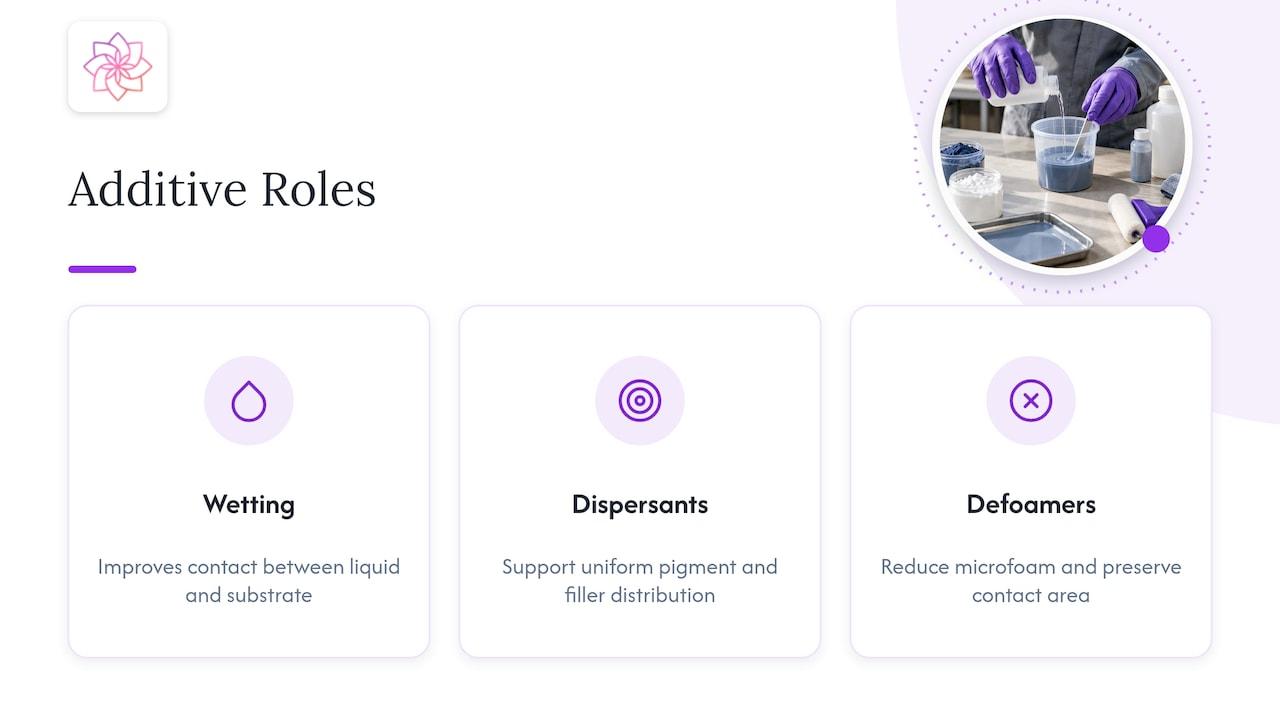
Wetting additives lower the surface tension of the liquid so it contacts the substrate completely. This addresses defects such as crawling, cratering and pinholes, which are a cause of local adhesion loss. It does not create covalent or polymer-entanglement bonds, so on a low-energy plastic a wetting agent by itself will not substitute for a promoter. Conversely, a promoter in a formulation with poor pigment dispersion or entrained air will underperform, because voids and agglomerates at the interface lower the effective bonded area.
Dispersants matter in a second way. Well-dispersed pigment and filler give a uniform film and stable rheology, and surface-treated fillers bond to the binder better when coupling agents are used. Defoamers matter because microfoam trapped near the substrate is a direct loss of contact area. Silicone and non-silicone defoamers differ in their effect on recoatability and surface defects, so the type chosen must be checked against the adhesion test, not only against foam height.
Evaluating performance and diagnosing failure
The test method must reflect the way the part fails in service. The JCT work cautions that peel strength can mislead because it introduces an extra film between the paint and the adhesion promoter, and uses compressive shear delamination for painted plastic. In the tested TPO systems, compressive shear results correlated with peel strength at 80% and with fracture toughness at 65%, with peel overestimating and fracture toughness underestimating adhesion and cohesion.
For development work this implies a short qualification matrix:
- Initial adhesion on the real substrate lot, with the production surface preparation.
- Aged adhesion after humidity, water immersion, thermal cycling or salt exposure appropriate to the end use.
- Failure mode recorded for every panel: adhesive failure at the substrate, adhesive failure between layers, or cohesive failure within the film or substrate. A high number with adhesive failure is a weaker result than a moderate number with cohesive failure.
- Dosage ladder with at least three levels, since excess promoter can form a weak boundary layer or reduce stability.
- Storage stability of the liquid formulation, especially with silanes and metal-organic promoters.
Interface chemistry can deliver measurable gains when it is matched to the substrate. A 2024 study reported that a covalent-bonding adhesion primer for polyolefins raised lap shear strength by 10% to 50% against plasma-treated substrates and remained effective after two months of storage. Such figures are specific to the substrate and the test, and they are a reason to run a controlled comparison rather than assume a result.
Troubleshooting common adhesion failures
| Observation | Likely cause | Direction to investigate |
|---|---|---|
| Coating peels cleanly from the substrate | Contamination, low surface energy, no coupling chemistry | Cleaning step, surface activation, promoter type |
| Adhesion good dry, lost after humidity or immersion | Hydrolytically weak interface | Silane or phosphate level, resin hydrophilicity, cure |
| Crawling or cratering on application | Poor wetting or contamination | Wetting additive, substrate cleaning, defoamer choice |
| Failure between primer and topcoat | Recoat window missed or incompatible chemistries | Intercoat timing, sanding, tie-coat |
| Promoter-containing batch gels or thickens | Premature condensation or reaction with other components | Moisture control, order of addition, compatibility |
Perspective
We approach adhesion as a formulation problem, not as a single additive purchase. In our experience with industrial coatings, adhesives, inks, plastics and composites, the interface rarely fails because of one ingredient. It fails because dispersion, foam control, rheology and the coupling chemistry were each optimized alone.
That is why our technical support starts from the substrate, the resin and the process, and works toward a dosage that is justified in the laboratory. Our dispersants, defoamers, rheology modifiers and functional additives are designed to keep the interface clean of voids, agglomerates and instability, so that whichever promoter chemistry a formulator selects can perform as intended.
Our positioning is comparable performance to premium brands at a lower total cost-in-use, supported by batch consistency and documentation for regulatory and production needs. For adhesion-critical systems we recommend qualifying the full formulation on production substrates, which is exactly the work our laboratory-backed qualification and customer collaboration are built around.
Astra R&D Team
Supporting adhesion with the rest of the additive package
ASTRA Chemical manufactures and supplies dispersants, silicone and non-silicone defoamers, rheology modifiers and functional coating additives, with technical support and custom formulation guidance for coatings, adhesives, inks, plastics and composites. In an adhesion program these products address the conditions around the interface: uniform pigment dispersion, controlled air release and stable rheology. The full range is listed on the coating additives product page, and the ASTRA PA® pigment dispersant page describes the dispersant line in detail. For reactive and terminal-group functional additives, the technical article on reactive diluents and functional additives explains dosage and selection.
Technical directors, formulation chemists and procurement teams can discuss a specific substrate and resin system with the ASTRA technical team through the ASTRA Chemical website, including sample requests for laboratory qualification.
Prices are not published and are quoted for bulk orders on request.
Selection checklist for formulators
- Identify the substrate family and its surface energy, and define the surface preparation that production can sustain.
- Decide between an internal additive, a surface treatment and a primer based on the process steps that already exist.
- Match the promoter's reactive group to the binder and the carrier (solvent-borne, waterborne or solvent-free).
- Confirm compatibility with the dispersant, defoamer and rheology package before scaling.
- Run initial and aged adhesion tests with a method suited to the failure mode, and log the failure mode.
- Establish a dosage window rather than a single point, and check storage stability.
- Obtain the safety data sheet and regulatory documentation for the finished formulation before release.
FAQ
What are adhesion promoters used for?
They improve the bond between a coating, ink, adhesive or sealant and a difficult substrate such as metal, glass, plastic or composite. Documented uses include printing inks, adhesives, plastics and composites, automotive components and electronics. They also help bond resin to fillers inside a formulation.
What is a silane adhesion promoter?
A silane is a coupling agent with hydrolyzable alkoxy groups at one end and an organofunctional group at the other. The alkoxy groups form silanols that bond to hydroxylated surfaces and condense into a siloxane network, while the organic group reacts with the resin. It is most effective on glass, metals and mineral fillers.
Can an adhesion promoter replace a primer?
Sometimes, when the substrate is already receptive and the promoter is added to the coating itself. On low-energy plastics or aged films a separate tie-coat or primer is usually the more dependable route. The answer should be confirmed on the actual substrate with an adhesion test.
Does a wetting agent improve adhesion?
It improves the contact between liquid and substrate, which removes defects such as crawling and cratering and increases the bonded area. It does not form chemical bridges. On difficult surfaces it supports a promoter and does not replace one.
Sources
- Adhesion promoter, Wikipedia
- Adhesion Promoters, 360iResearch
- Handbook Part 1, Adhesives & Sealants, March 2022
- Adhesion Promoter: Enhancing Bonds and Performance, Patsnap Eureka
- The Role of Adhesion Promoter and Substrate, JCT
- Adhesion and Cohesion, PubMed Central
- Surface Modification Chemicals Market, Mordor Intelligence
Testing additives for this application?
Send us your current formulation challenge and our technical team will recommend an ASTRA product package for lab screening.