Additive Compatibility Issues in Coatings and Adhesives
Additive Compatibility Issues in Coatings and Adhesives ! Separated coating samples on a compatibility bench Additive compatibility issues arise when a dispersant, defoamer, rheology modifier or surface additive is not sufficiently soluble or stable in the resin system, solvent or water phase it is…
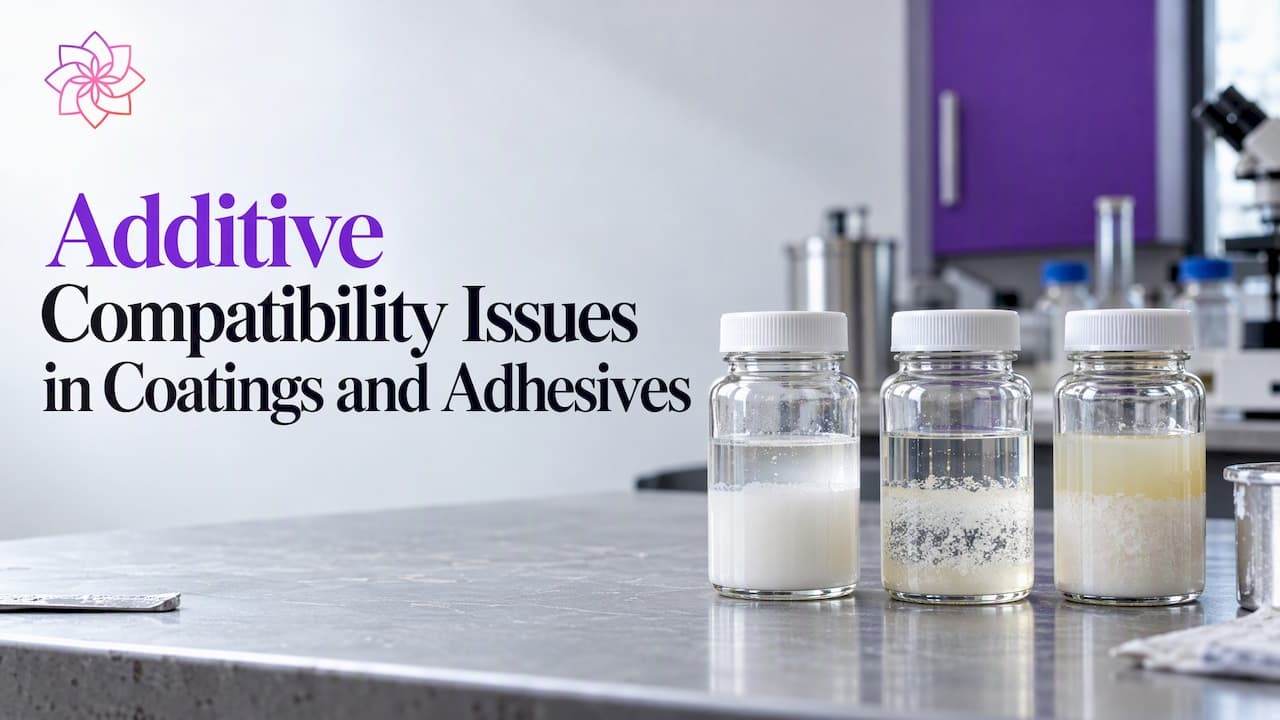
Additive compatibility issues arise when a dispersant, defoamer, rheology modifier or surface additive is not sufficiently soluble or stable in the resin system, solvent or water phase it is meant to work in, or when it interacts adversely with another additive in the same formulation. The result is visible as haze, craters, floating, viscosity drift or phase separation, and it frequently appears only after storage or after the film has cured. This guide explains the thermodynamic basis of incompatibility, the failure modes a formulator can observe, a stepwise method for testing and correcting it before scale-up, and how additive selection by function and chemistry reduces the risk.
TL;DR
- Incompatibility is primarily a solubility mismatch: when the additive and the binder differ too much in polarity, or in Hansen solubility parameters, the additive separates, migrates or fails to anchor.
- Typical symptoms are haze, gloss loss, cratering, flooding, poor wetting, poor recoatability, abnormal viscosity and precipitation after storage.
- Screening should combine short-term mixing checks with package stability, dilution stability and colorant acceptance work, for example along the lines of ASTM D5146 for solvent-borne architectural coatings.
- Correction usually means modifying one component, changing the additive chemistry, adjusting dosage or order of addition, or introducing a bridging material, never simply adding more of the additive.
- Selecting additives by function and chemistry from a documented product range, with laboratory-backed qualification, narrows the number of variables to be controlled.
In a coating or adhesive, an additive is typically present at a fraction of a percent to a few percent of the total formulation, yet it must perform at an interface: pigment surface, air-liquid boundary, substrate contact or the polymer network itself. To do so it has to be dispersed or dissolved well enough to remain mobile, while not being so soluble that it stays in the bulk and never reaches the interface. Compatibility is therefore a balance, not a binary property.
This balance is described quantitatively by Hansen solubility parameters (HSP). In his analysis of polymer additives, Hansen describes how compatibility is found when additive and polymer parameters are sufficiently close, while mismatches can lead to phase separation or poorer adhesion at solid surfaces. The same work points out that additives with distinctly different segments, such as surfactants, are designed to seek regions of similar energy, which is exactly what makes a wetting agent or dispersant work at a pigment surface and also what makes it sensitive to the surrounding medium.
Three levels of compatibility are worth distinguishing:
- Additive and binder or solvent system. Does the additive remain homogeneously distributed in the liquid and in the cured film?
- Additive and additive. Does a defoamer interact with a wetting agent, or does a dispersant compete with a rheology modifier for the same pigment or filler surface?
- Additive and substrate or subsequent layers. Does a surface-active component migrate and impair adhesion, recoatability or printability?
Each level fails in a different way and is diagnosed with a different test.
Why additives become incompatible
Polarity and solubility parameter mismatch
The leading cause is a difference in polarity between the additive and the continuous phase. Hansen's analysis links incompatibility in polymer systems to mismatched additive and polymer solubility parameters. In practical formulation work the same principle is applied to blends of resins: an excessive polarity difference between the main resin and an auxiliary resin can cause haze, gloss loss, phase separation, reduced transparency, abnormal viscosity or precipitation after storage. An additive carries the same risk on a smaller scale.
Temperature-dependent solubility
An additive may dissolve at the elevated temperatures of production or baking and then become supersaturated on cooling. Hansen notes that limited-solubility additives can migrate to the air surface upon cooling, appearing as dust-like particles for solids or as oil for liquids. A formulation that passes a bench check at room temperature immediately after mixing can therefore fail in a cold warehouse or after a thermal cycle.
Dosage above the solubility limit
Every additive has an effective window. Below it the function is absent; above it the surplus is not dissolved and acts as a foreign phase. For defoamers in particular, an excess of insoluble active droplets is a common source of surface defects, whereas a well-selected product incorporated under adequate shear remains finely distributed. Literature on coating defoamers emphasizes incorporation under high shear conditions for silicone-based products in order to avoid crater formation and similar side effects.
Competition at interfaces
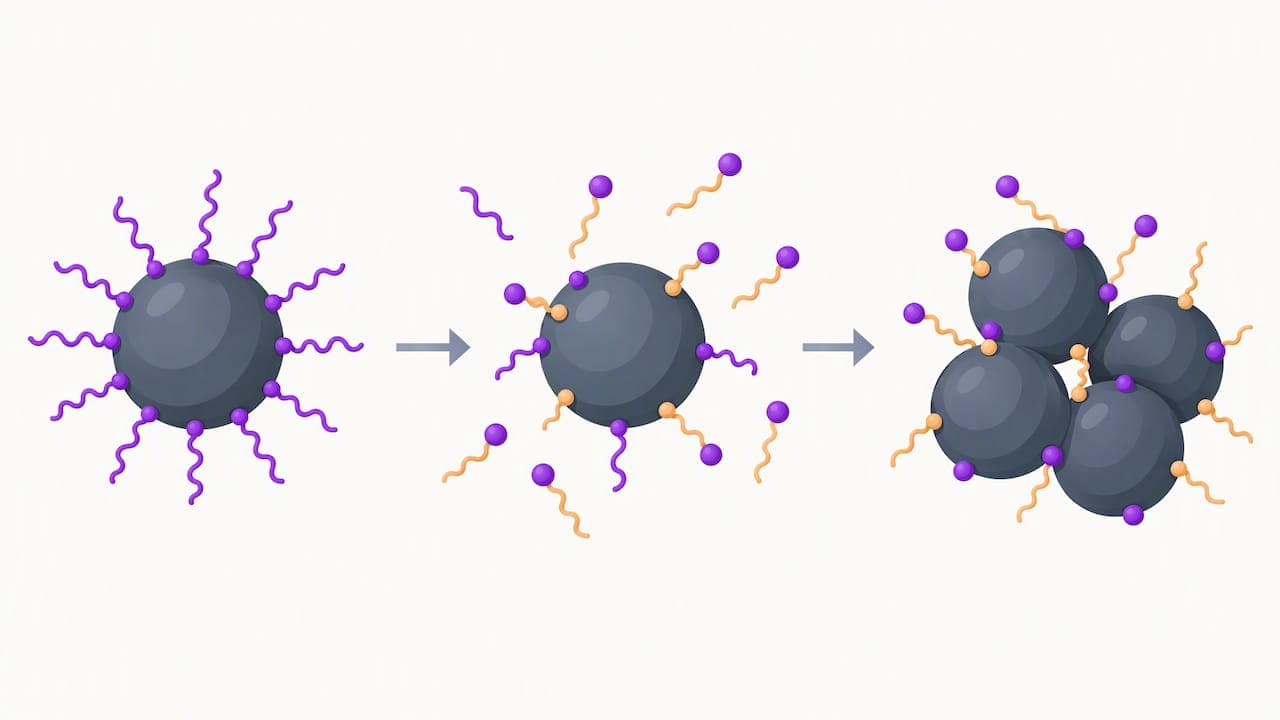
Surface-active additives share a limited interface. A dispersant adsorbed on a pigment surface can be displaced by a wetting agent with a stronger affinity, flocculation follows, and viscosity, color strength and gloss change. Similarly, a surface additive designed to migrate to the film surface can accumulate at the substrate interface in a thin film and impair adhesion.
Chemical reactivity
Additives with functional groups can react with the binder or hardener: acidic additives with amine-neutralized waterborne systems, reactive diluents or terminal-group additives with the crosslinker, or basic dispersants with acid-catalyzed systems. Such reactions can shift pH, accelerate gelation or reduce pot life. Terminal group chemistry is discussed further in the Astra Chemical technical article on reactive diluents and functional additives.
Observable symptoms and what they usually indicate
Symptoms are listed in the literature as haze, gloss loss, phase separation, reduced transparency, abnormal viscosity, precipitation after storage, floating or flooding, poor wetting, cratering and poor recoatability. Their appearance at a given stage narrows down the cause.
| Stage observed | Symptom | Most probable cause | First corrective check |
|---|---|---|---|
| Mixing or letdown | Haze, cloudiness, immediate separation | Strong polarity mismatch, or additive added to an unsuitable phase | Pre-dilute in a compatible solvent or carrier; test a more compatible chemistry |
| Mixing or grinding | Viscosity spike, shear thickening | Dispersant not anchoring, or competition between additives | Review dispersant type against the pigment surface; change order of addition |
| Storage | Sediment, syneresis, skinning, viscosity drift | Supersaturation, flocculation, slow incompatibility | Heat-age and freeze-thaw samples; reduce dosage |
| Application | Craters, fisheyes, poor wetting | Insoluble droplets, or surface tension imbalance | Check defoamer type and dosage; verify incorporation shear |
| Drying and curing | Floating, flooding, color difference between areas | Pigment segregation, dispersant mismatch | Assess pigment stabilization and solvent evaporation profile |
| End use | Gloss loss, haze, oily or dusty surface, poor recoat adhesion | Migration of excess additive to the surface | Lower dosage, switch to a better-anchored chemistry, assess recoat adhesion |
It should be noted that a single symptom can have several causes. Cratering, for instance, can originate in an incompatible defoamer, in surface contamination of the substrate or in a surface additive with excessive surface activity. Diagnosis therefore requires controlled variation of one factor at a time.
How to test compatibility before scale-up
Step 1: Define the interaction map
Before any laboratory work, list every component with its function, polarity and chemical type: binder, hardener, solvent or water, pigments and fillers, and each additive with its carrier. Mark the combinations most likely to compete at the same interface. Where HSP data are available for the resin and additive, compare them; where they are not, Hansen notes that experimental determination of solubility in a series of chosen liquids is often preferred.
Step 2: Run a simple ladder study
Prepare the base formulation without the additive and add it at several levels, for example at the low end, the recommended level and at twice the recommended level. The doubled level is a deliberate stress point: if haze, craters or flooding appear only there, the working window is defined and the safety margin is known.
Step 3: Apply standardized stability procedures
For solvent-borne architectural coatings, ASTM D5146 provides guidelines covering package stability, dilution stability and colorant acceptance. Even where a formulation is industrial rather than architectural, the structure of these tests transfers well: observe the sample after defined storage periods at elevated and ambient temperature, after dilution to the application viscosity, and after the addition of any tinting or color concentrate. Document viscosity, gloss, appearance, fineness of grind and any sediment at each point.
Step 4: Evaluate film properties, not only the liquid
A liquid that remains clear can still yield a film with surface defects. Draw down on the real substrate, and evaluate:
- cratering, fisheyes and leveling;
- gloss and haze at several angles;
- surface tack, oiliness or dust-like bloom after cooling or aging;
- recoat and intercoat adhesion;
- adhesion and bond strength to the actual substrate, for adhesives.
Step 5: Challenge the system with temperature cycles
Because solubility changes with temperature, include a cold storage step and a heat cycle. Migration of limited-solubility additives after cooling is a recognized mechanism, so a sample that has been warm and is then cooled should be reexamined for surface bloom.
Step 6: Repeat at pilot scale
Shear, temperature history and order of addition change between laboratory dissolvers and production vessels. Confirm results with a pilot batch using the same incorporation procedure intended for production, and record the batch-to-batch variation of the additive lot as well.
Diagnosing and correcting a compatibility problem
A systematic response preserves formulation performance because it changes one variable at a time and records the effect. The sequence below is the one most often useful.
- Confirm that the additive is the cause. Prepare a control without it, and a second control with the additive replaced by an equivalent from a different chemistry.
- Reduce dosage to the lower end of the window. If the defect disappears while the intended function is retained, the original level was above the solubility limit.
- Change the point and method of addition. Many dispersants belong in the grind stage, many defoamers in both grind and letdown, and many rheology modifiers need pre-dilution. Incorporation under adequate shear is frequently the difference between a stable emulsion of active droplets and visible defects.
- Select a chemistry closer in polarity to the system. Silicone and non-silicone defoamers, for instance, differ markedly in compatibility with a given binder, and a non-silicone type is often considered where silicone-related surface defects or recoat problems are a concern.
- Use a bridging material or modify a component. Hansen observes that compatibilizing steps can often be taken by systematically modifying one component or adding a well-chosen bridging material, which in practice may be a co-solvent, a carrier, or a different additive that mediates between phases.
- Retest the whole property set. A correction that cures haze but lowers adhesion, water resistance or gloss has only moved the problem.
Compatibility considerations by additive class
| Additive class | Principal compatibility risk | Practical safeguard |
|---|---|---|
| Dispersants | Weak anchoring on the pigment or filler surface; displacement by other surface-active additives | Match anchoring group to pigment surface chemistry; add early in grind |
| Defoamers, silicone | Craters and recoat issues when poorly dispersed or overdosed | Incorporate under high shear; stay within the dosage window |
| Defoamers, non-silicone | Lower efficiency in some systems if polarity does not match | Ladder study on the actual binder; evaluate foam and film appearance together |
| Rheology modifiers | Interaction with dispersants, surfactants and thickener competition; viscosity drift on storage | Pre-dilute where required; verify viscosity after aging |
| Wetting and leveling additives | Over-migration, foam stabilization, intercoat adhesion loss | Keep to the lowest effective level; evaluate recoat |
| Reactive and functional additives | Reaction with hardener or catalyst; shifts in pot life | Confirm reactive group compatibility; monitor gel time |
Perspective: how Astra R&D approaches compatibility
We regard additive compatibility as a design variable rather than a defect to be fixed afterward. A formulation is more robust when the function of every additive is defined first, and when each is selected from a coherent range with documented chemistry, rather than assembled from products of unrelated origin, each with unknown carriers and polarity.
In our experience, three practices reduce compatibility failures most reliably. The first is to qualify an additive in the customer's own binder system, at a dosage ladder, instead of relying on a generic recommendation. The second is to treat batch consistency as part of compatibility: a product that varies from lot to lot changes the solubility balance without any change in the formulation. The third is to keep the number of surface-active components to the minimum that the application requires, because each one adds an interaction.
We also work with customers on total cost-in-use, not only on unit price. An additive that requires a lower dosage, avoids rework and does not cause surface defects is usually less costly in production than a cheaper product that narrows the processing window.
— Astra R&D Team
Selecting additives with fewer variables
ASTRA CHEMICAL manufactures dispersants (ASTRA DISP®), rheology modifiers (ASTRA REO®), silicone defoamers (ASTRA DF®) and non-silicone defoamers (ASTRA DF NS®), together with functional and reactive additives such as ASTRA REACT®, for coatings, adhesives, inks, plastics and composites. Technical support, dosage guidance and sample requests are part of the supply relationship, so that compatibility can be confirmed in the customer's own system before bulk purchase. The full range is listed on the coating additives product overview, the pigment dispersant ASTRA DISP® page describes the dispersant line, and formulators with reactive systems can review ASTRA REACT®. Further technical articles are collected in the Astra Chemical technical blog.
Documentation that supports a compatibility decision
A compatibility study is only reproducible if the inputs are documented. For each trial, the following should be recorded and retained:
- additive name, lot number and carrier or solvent;
- dosage as active and as supplied, and the stage of addition;
- mixing equipment, speed, time and temperature;
- viscosity at defined shear rates before and after storage;
- fineness of grind, gloss, haze and film appearance;
- storage conditions and duration, including any cold and heat cycles;
- adhesion, recoat or bond results on the production substrate.
This record allows a procurement or quality team to qualify a second source, to trace a defect to a lot, and to demonstrate that a change of additive has been validated. It also provides the supplier's technical team with the information needed to propose a corrective action quickly.
FAQ
What is the difference between additive incompatibility and an additive overdose?
Incompatibility is a structural mismatch between the additive and the system, visible even at low dosage, whereas an overdose is a normally compatible additive used above its solubility limit. In practice the two overlap, since a marginally compatible additive has a narrow window. A dosage ladder study separates them: if defects occur only at the higher levels, the issue is the working window.
Why does a formulation pass initial checks and fail after storage?
Solubility depends on temperature and time. An additive of limited solubility can remain dissolved while the batch is warm and then become supersaturated on cooling, migrating to the surface as an oil or dust-like bloom. Flocculation by competing surface-active materials is also a slow process, so heat-aging and cold-storage steps are needed to expose it.
Can silicone and non-silicone defoamers be combined?
They can be, but the combination is a formulation variable that must be tested, not assumed. Different polarities and carriers can interact, and the result depends on the binder, the surfactant content and the incorporation method. Evaluate foam control, film appearance and recoatability on the real system before adopting a blend.
Which standards are relevant for stability testing?
For solvent-borne architectural coatings, ASTM D5146 gives a guide covering package stability, dilution stability and colorant acceptance. Industrial coatings, adhesives and inks usually combine such methods with internal specifications for viscosity, fineness of grind, gloss and adhesion. The customer's own acceptance criteria should be agreed with the additive supplier before qualification begins.
Can the supplier help diagnose a problem in an existing formulation?
Yes. Astra Chemical provides technical consultations and sample requests as part of supply, and the diagnosis is faster when the supplier receives the formulation, the symptom, the stage at which it appears and the test records described above.
Sources
- Hansen, C. M. (2004), Polymer additives and solubility parameters, Progress in Organic Coatings
- ASTM D5146, Standard Guide to Testing Solvent-Borne Architectural Coatings
- Resin Polarity in Coating Formulations
- Defoamers in the Coatings Industry, Chimia
Recommended
Testing additives for this application?
Send us your current formulation challenge and our technical team will recommend an ASTRA product package for lab screening.